As shown in my prior post, comparing the amount of bombs dropped on Dresden to other cities leads to some interesting and unexpected conclusions. See the chart below.
This chart shows that Dresden was hit mostly by high explosive (HE) bombs, and all three cities that I have collected data on were attacked with a majority of HE bombs. What is interesting about this is the way that the U.S. treats Incendiary bombs (IB) after the war. In the "Physical Damage Division Report" of the 1947 U.S. Strategic Bombing Survey (USSBS), the USSBS clearly states that incendiaries caused severe damage to cities, stating that:
"areas of cities measured in square miles were wiped out in single attacks or series of attacks and the loss of life was measured in thousands."1
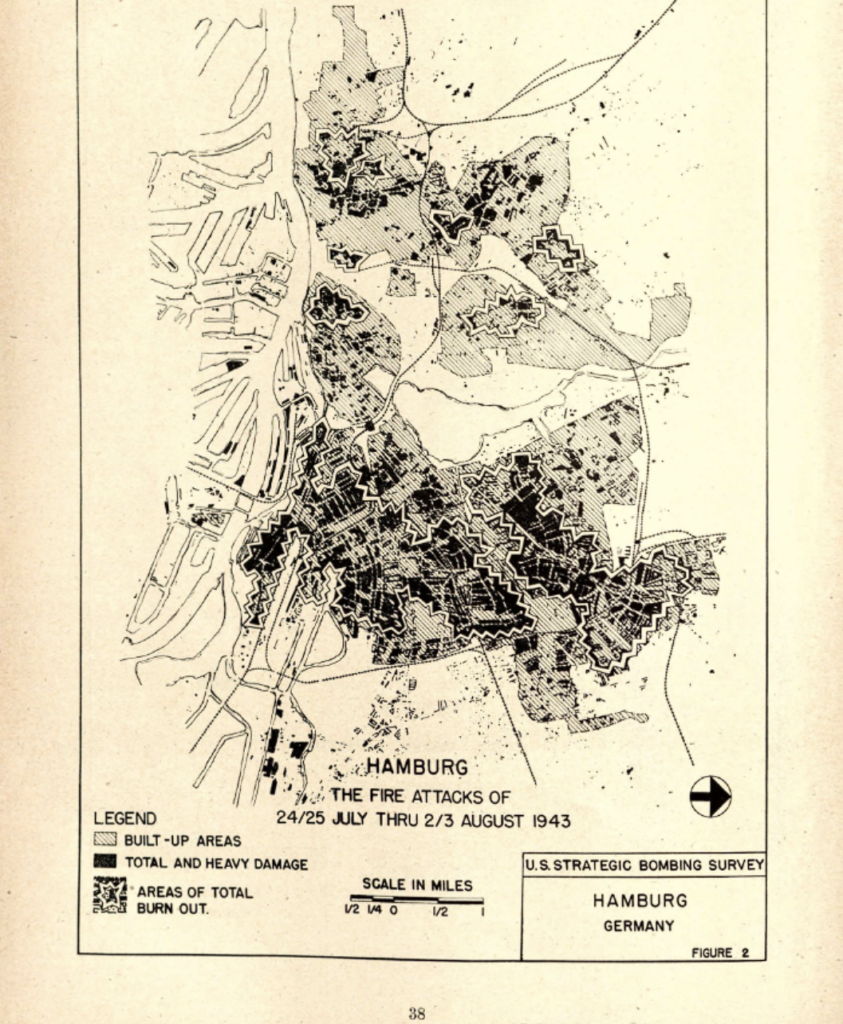
However, our data on the bombings shows that there were less incendiaries dropped on Dresden than Hamburg by a large margin. The Physical Damage Division reports that 45.5% of Hamburg's buildings showed signs of "visible damage" and that 75-80% of that damage was caused by fire, that is, incendiaries.2
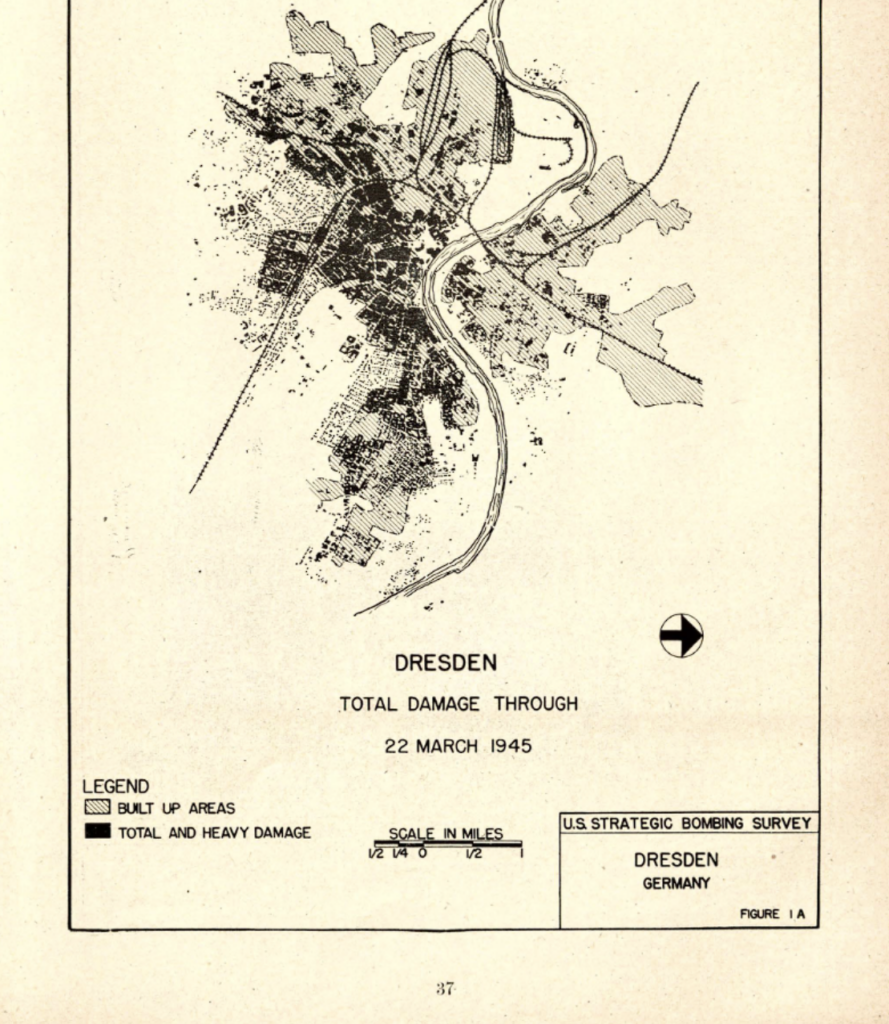
Even though I have yet to find a report which quantifies Dresden's destruction the same way as Hamburg and other cities, the map above, produced by the Physical Damage Division, shows that about 60% city was visually damaged as a rough estimate, but unlike Hamburg's damage as shown below, bomb damage is clustered mostly around the center of the city of Dresden.
While the first chart shows the total bombs dropped across the entire war, Dresden was still hit with less overall than Hamburg, and most importantly, less incendiaries. If incendiaries by themselves were so devastating, then why was Hamburg not more devastated than Dresden? The answer is not in the amount of bombs, but a difference in bomber tactics and technology. For example, the development and increasing use of new bombs, such as the incendiary White Phosphorus towards the end of the war, may have increased the damage potential of IBs per ton.
While I did not have the data to provide the tonnage of White Phosphorus dropped on Germany (beyond a guess as to how they would calculate that number), the fact that there is such an aggressive increase of its usage in 1944 and 1945 might have had an impact on the effectiveness of late war incendiary strategic bombing. The main and most destructive firestorm in Dresden occurred between the thirteenth and fourteenth of February, 1945, meaning that it is possible that many of the incendiaries dropped on Dresden were White Phosphorus amongst other bombs. White Phosphorus is particularly dangerous for a few reasons. For one, it could be put out with water, but after drying out, the substance could reignite, creating a new fire to continue burning the city.3 It also was harmful to citizens and German firefighters who tried to put it out, with the smoke causing skin burns.4 While by itself, that is dangerous, that is not only what fed the fires in Dresden. Conroy reports that the British R.A.F. planned to attack first at night with the purpose of igniting the city for the Americans to hit in the daylight of the fourteenth.5 The American bombers mostly dropped HE bombs on the city as shown by the 1953 Historical division report, though it is roughly a two to three split between HE and IB.6 The main reason for the delay in the American part of the plan is likely to rekindle the flames with more kindling. Conroy states that incendiaries were used to ignite broken houses and roofs destroyed by HE bombs, which would make the decision to have the Americans attack with their additional HE bombs later make more sense.7 This implies that the allies discovered that dropping everything all at once on a city would not be as effective as spacing out some of the ordinance to keep the city burning. Descriptions of the results of this are apocalyptic, with Conroy reporting that "Dresden burned for seven days and eight nights" following the attack.8 This is further evidence that the delayed additional HE might have extended the burning even further than if it was just hit by the British bombers, and the Americans hit Dresden with many fewer tons then, than they would drop in the coming months towards the end of the war.9
Bibliography
Conroy, Richard A. “Operation Thunderclap: The Bombing of Dresden:” Fort Belvoir, VA: Defense Technical Information Center, March 31, 1989. https://doi.org/10.21236/ADA209271.
United States Air Force Historical Division Research Studies Institute. “Historical Analysis of the 14-15 February 1945 Bombings of Dresden.” 13 April 1953. Air University. https://web.archive.org/web/20130218171142/http://www.afhso.af.mil/shared/media/document/AFD-110208-030.pdf. Accessed 20 October 2024.
United States Strategic Bombing Survey. “Fire Raids on German Cities.” 1947. https://aul.primo.exlibrisgroup.com/permalink/01AUL_INST/u9e6on/alma995580593406836. Accessed 20 October 2024
United States Air Force Office of Statistical Control. “Army Air Forces Statistical Digest: World War II.” Second Printing. December 1945. https://www.afhistory.af.mil/USAF-STATISTICS/. Accessed 20 October 2024
United States Strategic Bombing Survey. “Physical Damage Division Report (ETO).” 1947. https://aul.primo.exlibrisgroup.com/permalink/01AUL_INST/u9e6on/alma995578583406836. Accessed 20 October 2024.
- United States Strategic Bombing Survey, "Physical Damage Division Report (ETO)," 1947, 23. https://aul.primo.exlibrisgroup.com/permalink/01AUL_INST/u9e6on/alma995578583406836. [↩]
- Ibid, 35. [↩]
- Ibid, 52. [↩]
- Ibid, 52 [↩]
- Richard A. Conroy, “Operation Thunderclap: The Bombing of Dresden:” Fort Belvoir, VA: Defense Technical Information Center, March 31, 1989, 17, https://doi.org/10.21236/ADA209271. [↩]
- USAF Historical Division Research Studies Institute, “Historical Analysis of the 14-15 February 1945 Bombings of Dresden,” 13 April 1953, Air University, 37, https://web.archive.org/web/20130218171142/http://www.afhso.af.mil/shared/media/document/AFD-110208-030.pdf, Accessed 20 October 2024. [↩]
- Conroy, "Operation Thunderclap," 24. [↩]
- Ibid, 29. [↩]
- USAF Historical Division, 1953, 37. [↩]